
Making your own luck
It's never been more important to move beyond the average.

The gap is widening between people that work to live and people that live to work. We are seeing more parity than ever before, with unique differentiation increasingly difficult for your average worker—it has never been more important to care deeply about everything you dedicate your time toward.
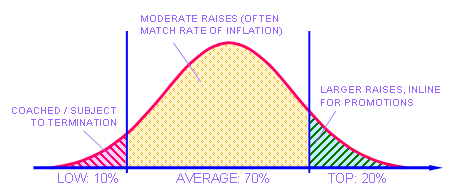
Large companies have always stack-ranked employees (either implicitly or explicitly), and have had to accept the fact that not everyone in their organization will be top performers. I know of managers that explicitly curate 1-2 low or average performers on their teams to serve as sacrificial lambs in layoffs.
However, the shift taking place today, particularly in the largest companies, is flatter and leaner teams, filled with all-stars and an unlimited token budget. There is no room on these teams for low or average performers—AI is distributed unevenly today and this share shift will only continue to accelerate as Forward Deployed Engineers get stuck into traditionally non-AI native companies. The floor is rising quicker than the rate at which today’s average worker is adapting.
Oversimplifying a little, an employee performance calculation is as follows, with output being a reflection of work product (laddering up to business objectives) and contributions to team culture:
Is my employee producing output that is in excess of the salary they are being paid (and their token consumption)?
Is my employee producing output at a greater quality than someone I could hire for the same or less salary from elsewhere?
Is my employee improving their output over time?
Is my employee doing things an automation or AI agent can’t?
Take two employees in the same role, doing the same task.
Employee A submits a prompt, picks up their phone, scrolls short-form content until a response is ready, rinse-and-repeat. They brute-force successful outputs with significant multi-turn conversation. If AI can help them automate operationally taxing work and shave off an hour in their 9-5 workday, they will be happy.
Employee B submits a prompt, then switches tabs to review outputs and provide feedback from their 5 other terminal windows. They build workflows and skills to automate repetitive work, and use the freed up time to focus on higher leverage thinking.
There are more of Employee A than Employee B at any large company today, not to mention Employee C who still refuses to try using AI based on their experience with GPT3.5 four years ago. Employee B is accomplishing things 1.5-2x faster (and likely more effectively) than Employee A.
Interestingly, the meaningful differentiator to becoming an AI-native top performer is not much different from the pre-AI world, it’s just significantly more important given the rising floor.
Here is my advice for how to do so, particularly for young professionals entering Corporate America and trying to stand out in a sea of sameness:
Note: A pre-requisite for all of this is doing excellent, high-quality work.
Be curious, and expand the breadth of your curiosity constantly
Become a subject matter expert in your product area as quickly as possible. Identify who does what, how what you’re working on ladders up to the broader vision, speak in the same terms your team does, and consume as many artifacts as possible (videos, documents, wikis, etc.).
Curiosity will enable you to see connections others don’t, and suggest things that have been overlooked. Curiosity also opens doors that would have otherwise remained firmly closed. People will take notice, remember you, and tap you for new opportunities.
Say what you will do, and do what you say
Consistently delivering on what you commit to is an obvious but often over-looked skill. It is incredibly easy to say yes to something. A random action item from a meeting, a chat from a teammate, an ask from your manager.
Following through on it and seeing it to completion is significantly more challenging, because of the frequency at which these requests are made, and the priorities that require juggling from your ever-expanding set of stakeholders. See #3 below.
Be selective with what you commit to, but do those things well
Once you start proving yourself, you will naturally become someone that people across an organization come to with asks. This is a good thing, but leads to more inbound than is humanly possible to deliver with a high quality standard.
You should optimize to do a few things well rather than doing many things just OK. People will generally remember the last thing you did for them, not the collective sum of your work.
AI is making this easier. With sufficient context, AI can enable you to take on significantly more work than you were previously capable of handling, but, exercising judgement and transforming AI outputs is incredibly important.
No task is beneath you—do things others can’t or don’t want to do
You were hired to add capacity to the team. To fill gaps that weren’t previously addressed. To support initiatives previously not possible. To add fresh perspective and new thinking.
Especially when you first start out in a new job, take on many diverse initiatives to 1. understand the full breadth of work required to achieve success in your role, and 2. identify where your skills and interests align to provide maximum unique and differentiated value.
As you identify the intersection of your interests and ability, go deeper in those areas.
Suggest rather than question
Your team doesn’t need another person to comment in your document, “what does this mean” or “this doesn’t make sense”— that’s what their managers and leaders are there for ;).
When you come across something that you have sufficient context to weigh in on, directly suggest how you would reframe or modify it to match your line of thinking. If it makes sense, your teammate will improve the quality of their output, but also (and more critically) think higher of you because you’re demonstrating your understanding of the subject and contributing to its refinement.
Error on over-communicating over under-communicating
If you’re thinking about sending an update to your team and hesitate because you think it’s not meaningful enough, send it. Over-communicating and communicating publicly is incredibly important.
Your ideas and work are not limited to you being asked to do something and you doing it. It is a constant evolution of scope based on the work of others on your team, the priorities of your leaders, and your self-determination of what the highest leverage use of your time is. Over-communicating enables your progress and ideas to proliferate throughout your organization to facilitate the natural emergence of watchouts, complimentary work, and shifts in scope before too much time is wasted.
Study incentives and proactively offer value
Study your organization and form a general sense of who is working on what. Read between the lines of statements made by your leadership. Understand the incentives across the different functions contributing to your product area. Identify structural inefficiencies and build systems that address them.
Building a scaled product often takes the collaboration and alignment of 5+ different functions and teams. If you understand their leaders, their IC objectives, and what motivates them, you’ll be significantly more effective in recruiting collaborators.
If you do your work in a silo, you risk producing outputs that are duplicative and/or in conflict with helpful steer along the way from teammates and leaders.
Be naive, and push for extreme clarity
Question everything; gaps in your understanding, inefficient systems, bureaucratic processes, and anything else that feels like it is not correct or optimal. Products are being built by people just like you, and tunnel-vision often results in obvious gaps not seen by people too in the details. This is a superpower as someone new and curious.
The question you have in your head is likely on at least one other person’s mind. Don’t leave the meeting without asking the question that will drive clarity for the team. Closed mouths don’t get fed, and unproductive organizations thrive when everyone isn’t on the same page.
Optimize for brevity, be concise
Much of Corporate America functions off of emails, chats, documents and presentations. As you create these artifacts, remove as much as humanly possible without losing your key points.
Never publish the first version of something. Attention is in short supply, and you will make your organization more productive by removing AI slop and other irrelevant content. People will appreciate you for being concise and articulating yourself clearly. Be explicit about your objective, asks, and key content to review.
Sweat the details, demonstrate your craft
Take pride in all work that you put out. You are a craftsman, creating purpose-built outputs based on your knowledge and opinions. Do things because you genuinely have an interest in them, and weed out things that drain you. Value compounds over time and your career is one giant snowball rolling down a hill.
This is an imperfect list that will continue to evolve over time as I continue learning. I’ve seen great success in continuously updating my priors based on new information and this list is no exception.